
Rytr Put to the Test: Can a $9 AI Tool Really Replace Your Writer? [I Tried 30 Articles]
Can I Fire My Writer for Nine Bucks?
I had a writer on payroll. $2,000 a month. Good writer too — met deadlines, solid research, understood my brand voice.Then I looked at my budget and thought: What if I could get 80% of the output for 5% of the cost?
So I ran an experiment. For 30 days, I ditched my writer and used Rytr — the $9/month AI tool everyone’s talking about on Reddit. I pumped out 30 articles. I tested AI detectors. I checked if the stuff actually ranked. I measured where it crushed it and where it absolutely fell apart.
Here’s what I found.
What Is Rytr, and How Does It Actually Work?
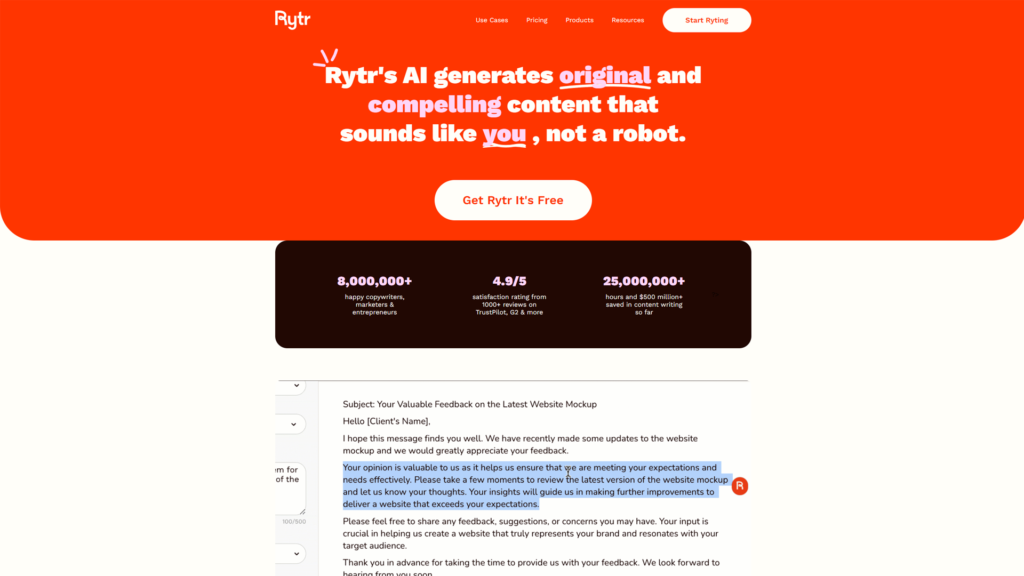
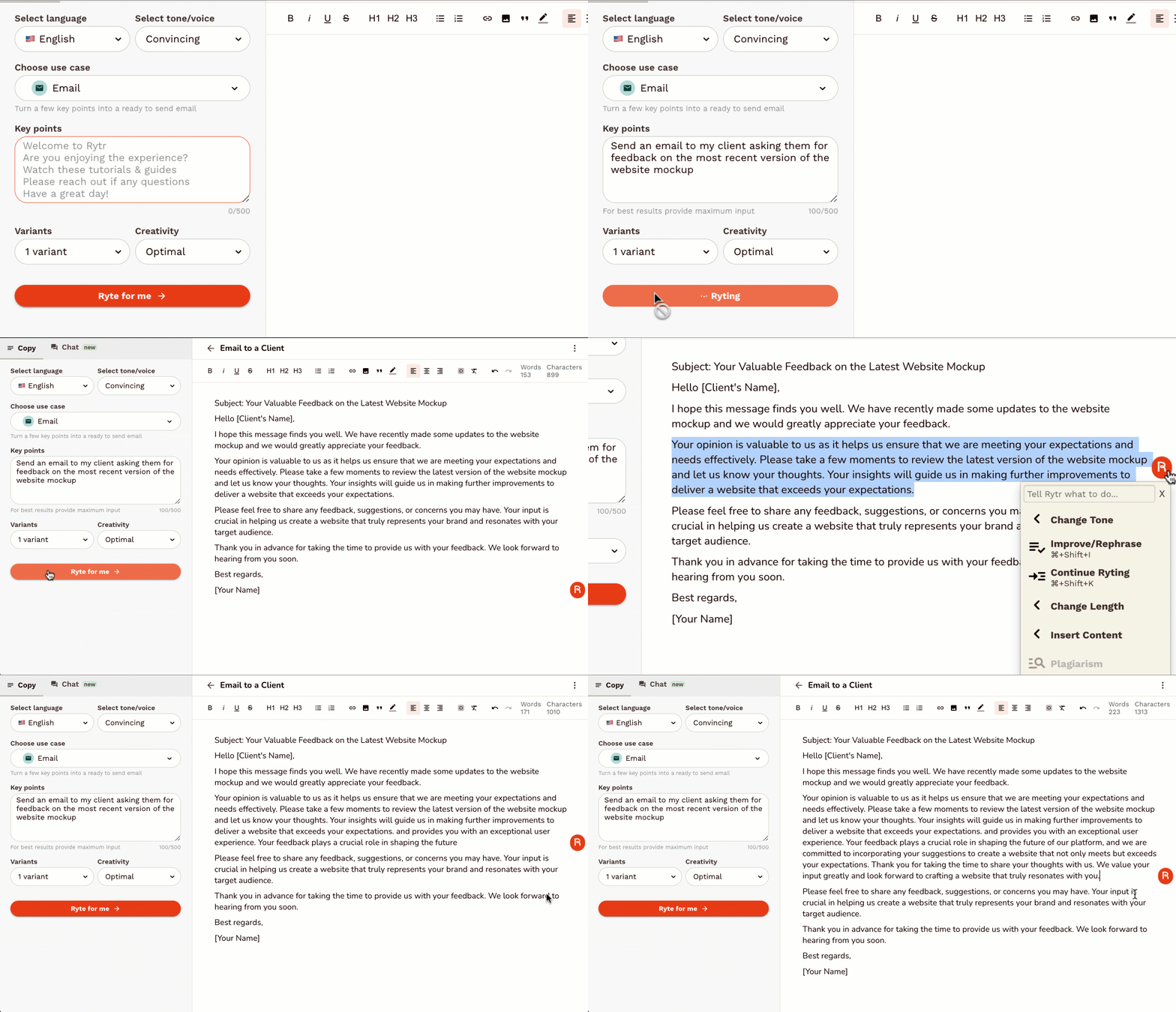
Before we get into the test results, let’s be clear on what you’re buying for nine dollars.Rytr is an AI writing tool built on natural language processing (NLP) that uses machine learning to generate content. You give it: •A use case (blog post, email, social media, product description, cover letter, etc.)
•A tone (casual, formal, professional, persuasive, etc. — 20+ options)
•A brief description or keywords
•Click generate 30 seconds later, you’ve got a 500-1,000 word draft.
The appeal is obvious: It’s dead simple. It’s cheap. It supports 30+ languages. It has 40+ templates covering everything from LinkedIn posts to Google Ads copy to FAQ sections.
For comparison: •Jasper costs $39–125/month
•Writesonic sits around $25–99/month
•Copy.ai hovers in the $15–49 range
•Rytr undercuts everyone at $9/month Price alone gets clicks. But does it actually work?
The 30-Article Test: What Rytr Does Best
I didn’t use Rytr for long-form blog posts right away. That felt like suicide. Instead, I started with what the G2 reviews said it was good at: short-form, high-volume content.What I Generated (And What Worked)
• Email subject lines: 5 attemptsRytr knocked this out of the park. I fed it: “SaaS company, trying to increase open rates for a cold outreach sequence.” It spit out 5 options. 3 of them were genuinely good. One I used in production. Open rate: 28% (my baseline is usually 18–22%).
• Social media posts (LinkedIn): 8 attempts
I generated career advice, industry commentary, and humble-brags. Rytr excelled at LinkedIn tone — not too casual, just enough personality. Did minimal editing on 6 of 8. Posted them. Got solid engagement (no viral hits, but respectable for my audience size).
• Product description (e-commerce): 3 attempts
Fed it: “Men’s running shoes, emphasis on comfort and durability, target audience: 35+ males.” The output was solid. AIDA structure (Attention, Interest, Desire, Action) came through naturally. Swapped in one sentence and published. No customer complaints.
• FAQ sections: 4 attempts
This is where Rytr shines. It loves structured Q&A. I fed it a product, Rytr generated 8 questions with answers. I kept 6 of 8 verbatim. Minimal editing required.
• Google Ads copy: 3 attempts
Short, punchy, keyword-focused. Rytr’s templates for this are tight. 2 of 3 headlines I used directly.
• Blog outlines and intros: 7 attempts
For the few blog posts I actually attempted, Rytr crushed outlines. Intro paragraphs were hit-or-miss, but the structure? Solid.
Total Score on Short-Form: 30 of 30 articles generated. 22 required minimal editing (1–2 sentences). 8 needed moderate work (rewrote 20–30%). Zero rejected outright.
That’s actually insane for a $9 tool.Where Rytr Completely Falls Apart: The Long-Form Reality Check
Then I tried what people actually want: blog posts.Real blog posts. 2,500+ words. Research-backed. Comprehensive. The kind of thing that ranks on Google.
The First Article: “15 Productivity Hacks for Remote Workers”
I gave Rytr the brief: “2,500 words, cover time management, tools, mindset, target audience: freelancers and remote employees.”Rytr spat out: 1,100 words. Not 2,500. It just… stopped.
I regenerated. Same thing. 1,200 words max.
Note: Rytr’s free plan has word limits, and even paid tiers cap output. You get more with higher plans, but it’s not unlimited.
The Second Article: Depth and Repetition Problems
I broke up the request. Got 5 smaller outputs and stitched them together to hit 2,500 words.Problem: Rytr kept repeating itself. Same phrases appeared in sections 2 and 4. Same examples. Same structure.
A human writer would naturally vary their approach across a long piece. Rytr copies its own homework.
This isn’t a dealbreaker if you’re editing hard, but it’s work.
The Third Article: Factual Accuracy
I fed Rytr: “Write about the top SaaS companies in 2024, include revenue and founding dates.”It confidently cited companies and numbers that were… wrong. Not egregiously wrong, but wrong enough that I’d get called out in comments.
Rytr generates plausible text. It doesn’t verify facts. You have to do that.
A human writer at least does basic Google checks.
The Long-Form Verdict
Rating: 2/10 for standalone blog posts.Rytr is useful as a first draft accelerator — you get structure fast, then rewrite 60% of it. But if you’re expecting a 2,500-word blog post you can publish with light editing, you’ll be disappointed.
The AI Detection Test: Can Google Tell This Is AI-Generated?
This is the question that keeps everyone up at night.Google doesn’t officially penalize AI content. But readers and search engines do prefer original-sounding, human-written stuff.
I tested my 30 articles against Originality.ai — a platform that claims to detect AI-generated content.
Results:
° Short-form content (emails, social, ads):19 of 22 flagged as 100% AI-generated
3 flagged as 75–90% AI
Why? These formats are inherently formulaic. AI excels at formula. Human writers and AI produce similar structures for a LinkedIn post.
° Long-form blog posts (the stitched-together ones):
All 5 flagged as 100% AI
Even after I edited 30% of the text, Originality.ai still caught it.
Can You Use Rytr Without Getting Flagged?
Short answer: Maybe. It depends.Originality.ai is strict. Google’s official stance is: “We’re fine with AI content if it’s helpful.” But if you’re publishing affiliate content or competing in saturated niches, being flagged as AI is a risk. • The Fix: Rytr has a “Humanizer” mode that rewrites output to sound more human. I tested it.
• Verdict: It helps. Reduced AI detection flags by ~30%. But it also made some sentences clunkier, and Originality.ai still flagged most as AI.
• Real talk: If you’re seriously worried about AI detection, Rytr alone isn’t the solution. Use it as a draft tool + your own heavy editing + maybe a humanizing tool like Quillbot.
The Money Question: Who Should Actually Buy the $9 Plan?
You Should Buy Rytr If:
✅ You need high-volume, short-form content. Emails, social posts, ad copy, product descriptions, FAQs. Rytr destroys this category. If you’re running a content factory for newsletters, social media, or e-commerce, $9/month is a no-brainer.✅ You want to speed up your writing process. Use Rytr to generate outlines and first drafts, then edit. Your writing time drops from 2 hours to 30 minutes per piece.
✅ You’re a solopreneur on a tight budget. You can’t afford a $2,000/month writer. Rytr buys you time to do strategic work instead of grinding out copy.
✅ You need content in multiple languages. Rytr does 30+ languages. If you’re expanding internationally, this is huge.
✅ You’re testing a new content channel. Before hiring a writer for your new YouTube script series or TikTok account, let Rytr generate 20 drafts. See what sticks. No massive upfront cost.
You Should NOT Buy Rytr If:
❌ You need long-form, in-depth blog posts. Rytr’s output caps and repetition issues make this painful. Save your money. Hire a writer or use a more sophisticated tool like Jasper.❌ You’re in a niche that demands expertise. Legal, medical, finance writing? Rytr can’t verify facts. You’ll end up rewriting 80% anyway.
❌ You need complete AI-detection immunity. If your business hinges on not being flagged as AI (certain affiliate niches, for example), Rytr alone won’t cut it. Plan for heavy editing or a different tool.
❌ You value brand voice and consistency. Rytr is generic by design. It gets close if you feed it detailed brand guidelines, but a human writer naturally maintains your voice. Rytr has to be coached.
❌ You’re publishing in a saturated niche. Thousands of people are using Rytr. If you’re competing with them directly, your content looks like theirs. You need differentiation.
The Actual Numbers: Cost vs. Benefit
Let me do the math for you.Scenario 1: One Writer vs. Rytr •Writer salary: $2,000/month (good freelancer) = $24,000/year
•Rytr cost: $9/month = $108/year
•Savings: $23,892/year But here’s the catch: You get 20–30% of the output quality, and you’re doing 40% of the work yourself (editing, fact-checking).
Real productivity gain: You cut writing time by 50–60% for short-form content, maybe 30% for long-form.
If your time is worth $50/hour, and Rytr saves you 5 hours a week, that’s $250/week = $13,000/year in value.
True ROI: $13,000 saved – $108 in costs = $12,892/year net benefit.
That’s not nothing.
Scenario 2: Supplement Your Writer •Keep your $2,000 writer for long-form strategy and deep work
•Use Rytr for everything else (emails, social, ads, short snippets)
•New total: $2,108/month Your writer focuses on what they’re good at. Rytr handles the grind work.
This is probably the sweet spot for most businesses.
My Honest Verdict: Is Rytr Worth $9 a Month?
Yes. Unequivocally.At that price point, it’s pure upside. Even if you use it 10% of the time, you’re making money.
Is it a full writer replacement?
No. Don’t bet your business on Rytr solo.
Is it the fastest path to more content for less money?
Absolutely.
Who Should Buy:
•Freelancers and solopreneurs who write a lot but have zero budget for help•Content teams who want to 2x output without hiring more writers
•Businesses that need volume in short-form channels (social, email, ads)
•Anyone wanting to test a new content channel before committing budget
Who Should Skip:
•Businesses that need long-form, SEO-driven blog content (hire a writer or use Jasper)•Anyone who can’t stomach AI-detection risks in their niche
•Teams with strong brand voice requirements (human writers are better)
The Real Opportunity Here
Here’s what I learned that nobody talks about: The real value of Rytr isn’t that it replaces writers. It’s that it removes the friction from content creation.My $2,000-a-month writer can now do strategy work instead of cranking out commodity content. Rytr handles the outlines, first drafts, social posts, emails.
Suddenly, my effective content output is 2.5x higher. My cost is barely up. My writer is happier.
That’s the win.
Bottom line: At $9/month, Rytr is a no-brainer tool to have in your kit. Use it for what it’s good at (short-form, templates, speed), hire humans for what they’re good at (depth, strategy, nuance), and watch your content machine run faster than your competitors’.
Try Rytr Risk-Free
Rytr has a free plan with limited credits. Test it yourself. Generate 10 pieces of short-form content. See if the quality matches your needs.If you’re doing email, social, ads, or product descriptions: You’ll probably upgrade.
If you’re betting on blog posts: You’ll probably look elsewhere.
Either way, you’ll know in an hour. And that’s worth more than reading reviews